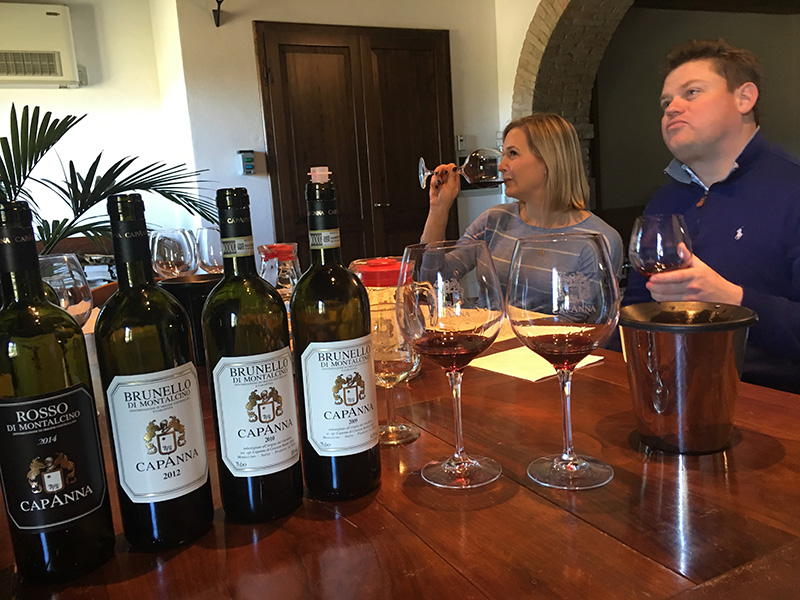
We actually smell most of the things that we think we taste,
or so the scientists say.
Our poor taste buds can discern only four flavors - sweet,
sour, salt and bitter - while our noses are capable of distinguishing
thousands of subtle variations.
There's nothing like a summer cold or allergy attack - with
its attendant loss of the sense of smell - to bring this theory
out of the laboratory into the real world.
If you like wine and catch a cold, you're well advised to
switch to soft drinks, pure spring water or something equally
undemanding until the sniffles have passed and you can again
enjoy the olfactory nuances that make wine something special.
The wines of the world offer thousands of scents in their
almost infinite variety. I must have smelled a few hundred
things in wine myself, ranging from the commonplace (grapes
and fruit) to the off-the-wall (sawdust and asparagus) and
the disgusting (dirty socks and wet dog fur).
As an aid to novice wine tasters - and experts too - the
wine scientists at the University of California at Davis,
one of the nation's leading wine-making and grape-growing
schools, came up years ago with something called the "aroma
wheel."
The oenologists at Davis consulted with scores of wine lovers
and wine tasters to list all the descriptive terms they could
imagine for the smells of wine. Then they organized them,
categorized them, eliminated all that seemed ambiguous or
less than clear, and ended up with a list of 12 major categories
of wine smells, subdivided into 29 subcategories and in 94
specific terms.
The original "wheel" was so called because it was
displayed as a circular table, with relatively similar smells
placed close together around its circumference. (Colored plastic
laminated copies of the wine aroma wheel may be obtained from
A.C. Noble, Dept. Vit. & Enology, Univ. California, Davis,
Calif 95616.) The wheel can be viewed on the UCDavis Website.)
You don't need a wheel to get rolling, however: The information
is just as useful in the form of a list, starting at noon
and moving around the clock from "fruity" through
"nutty" and "earthy" around to "floral,"
"spicy" and back to fruity again.
If you want to get more out of your wine, try your next tasting
session with the list at hand, scanning the categories in
search of the exact word to describe what you're smelling.
I think you'll be surprised to see how a glance at the "wheel"
helps your thoughts snap into focus.
I've edited the following list somewhat to save space, leaving
out some of the more obscure and technical terms, but you'll
find all the usual aromas rounded up here:
FRUITY: Citrus - grapefruit,
lemon; berry - blackberry, raspberry, strawberry, black currant
(cassis); tree fruit - cherry, apricot, peach, apple; tropical
fruit - pineapple, melon, banana; dried fruit - strawberry
jam, raisins, prune, fig.
VEGETATIVE: fresh - stemmy,
cut green grass, bell pepper, eucalyptus, mint; canned-cooked
- green beans, asparagus, green olive, black olive, artichoke;
dried - haw-straw, tea, tobacco.
Use the "wheel" as a guide when you're tasting
wine for fun, and I think you'll be surprised to see how well
this list of descriptive terms will help you recognize those
elusive characteristics.
This brings our quick online wine course to a conclusion.
If you'll remember two simple rules - (1) think about wine,
and (2) keep opening bottles - you'll soon be on your way
to expertise and a lifetime of enjoyment. Good luck, and good
wine!